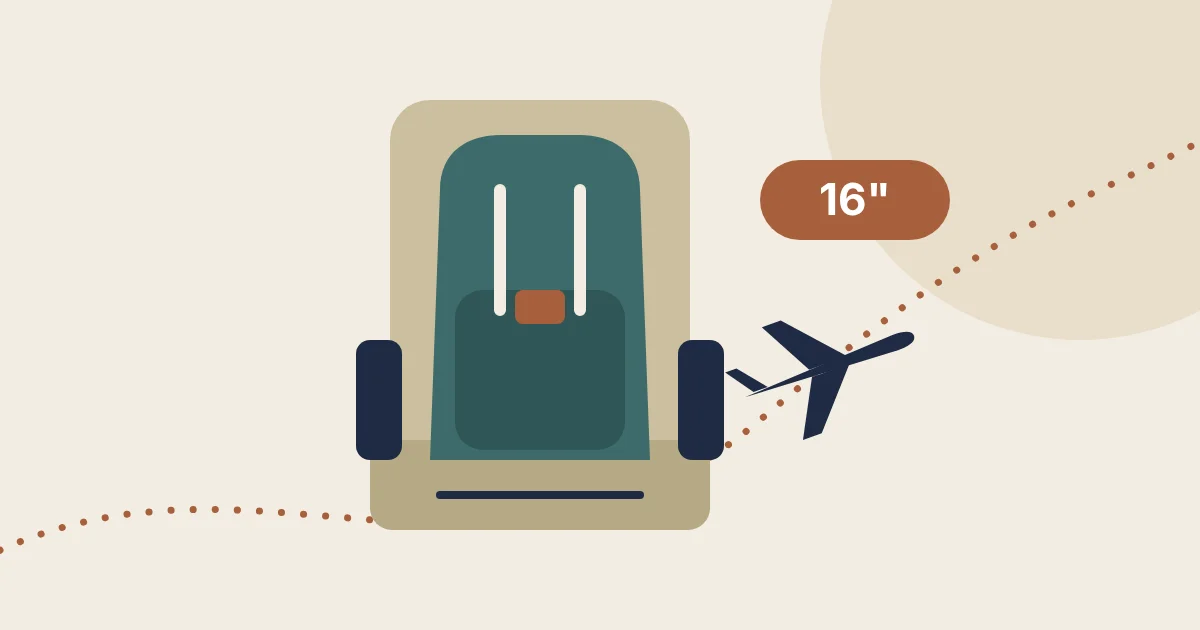
Short answer: the FAA says the safest place on a plane for a child under 2 is an approved car seat in their own seat, not your lap. A seat works on board only if it carries the label "This restraint is certified for use in motor vehicles and aircraft", and the FAA says a seat no wider than 16 inches should fit most airplane seats. Booster seats can't be used for taxi, takeoff or landing. For a light convertible seat that fits, get the Maxi-Cosi Romi. For a baby, the Chicco KeyFit 30 carrier. For a child of 22 to 44 pounds, the CARES harness replaces the car seat on the plane.
Affiliate note: As an Amazon Associate, The Finer Route earns from qualifying purchases. That costs you nothing extra. I haven't tested these seats: my picks are based on the FAA's own guidance, the makers' published limits, widths measured by child passenger safety reviewers, and what owners say in their reviews, including the complaints. Always follow the manual that comes with your seat.
The holidays are when most families fly with little kids, and the car seat is the piece of gear that causes the most stress at the airport: will they let it on, will it fit between the armrests, and what do you do with it at the other end? Our family of four has done our share of long travel days, and the answer is almost always the same: the seat itself decides how smooth the day goes. A narrow, light seat with the right label goes on in two minutes. A wide, heavy one turns boarding into a wrestling match.
Below is what the FAA actually requires, a checker for your own seat, five seats and a harness that work on planes, the bags and carts that get them through the airport, and what changes when you land in Europe.
Maxi-Cosi Romi
About 17 inches wide and just over 9 lb. Certified for airplane use.
Check price on AmazonChicco KeyFit 30
Infant carrier, FAA approved, about 9.4 lb without the base.
Check price on AmazonCARES Harness
FAA-certified harness for children 22 to 44 lb, up to 40 inches.
Check price on AmazonFlying for Thanksgiving or Christmas? Order now so you can practice installing the seat with a plain lap belt at home. It is much easier to learn on your couch than in row 27 with a line of people behind you.
What the FAA actually requires
Checked October 22, 2026, on the FAA's "Flying with Children" and child safety seat pages. These rules apply on US airlines; foreign airlines set their own, so check yours before you book.
- The label. Your seat must say "This restraint is certified for use in motor vehicles and aircraft." It's usually a sticker on the side or back of the shell, often printed in red. No label, no seat on board.
- Your child needs their own ticket. The FAA says buying a seat for your child is the only way to guarantee you can use a car seat. A lap infant can only use a car seat if there happens to be a free seat next to you.
- Airlines must let you use it. If your child has a ticket and an approved seat, the FAA says airlines must allow it. If it doesn't fit a particular seat, the airline must find another seat for it in the same class.
- Window seat, never an exit row. The car seat can't block anyone's way out, so it usually goes by the window. Many airlines also keep it out of the rows right next to an exit row.
- No boosters, vests or baby carriers for takeoff and landing. The FAA prohibits booster seats, backless seats and baby carriers during taxi, takeoff and landing. You can bring a booster on board for the car, but it goes in the overhead bin.
- The FAA strongly discourages lap children. Children under 2 are allowed on a parent's lap on US flights, but the FAA recommends an approved car seat or device instead.
Economy seats on US airlines are typically about 17 to 18 inches between the armrests, and airlines are required to publish the width of their narrowest and widest seats for each aircraft type. That's why the FAA's rule of thumb is a seat of 16 inches or less. A seat a little wider often still fits with the armrests raised, but an armrest that won't go up, or a narrow regional jet, can turn a 19-inch seat into a problem.
Will your car seat work on the plane?
Measure your seat at its widest point, usually the cup holders or the wings by the head. Then fill in your child's weight and height.
Choose what you're bringing to start.
Car seat, harness or seat belt: which does your child need?
| Your child | On the plane | Why |
|---|---|---|
| Baby, up to the infant seat's limit | Infant carrier with the aircraft label, rear-facing | The FAA says an approved seat is the safest place for a child under 2. Most infant carriers install on a plane without the base. |
| Toddler under 22 lb who has outgrown the carrier | Convertible car seat, rear-facing | Too small for the CARES harness. |
| 22 to 44 lb, up to 40 inches | Convertible car seat or CARES harness | Both are approved. The harness is far lighter to carry; the car seat is familiar and you need it in the car anyway. |
| Over 44 lb or taller than 40 inches | Airplane seat belt, or a harnessed seat if it still fits | Boosters can't be used for takeoff and landing. |
If you need the car seat in a car at the other end, bringing it on board is usually better than checking it: it arrives with you, and it doesn't get thrown around with the suitcases. If you don't need it on the plane, a padded bag and a gate check are the next best thing.
Our 5 picks for flying
All of these list aircraft certification. Widths are the widest point as measured by the child passenger safety reviewers we cite, or as the maker lists it. I haven't tested them.
| Seat | Type | Child limits (maker) | Width | Seat weight |
|---|---|---|---|---|
| Maxi-Cosi Romi | Convertible | Rear 5–40 lb, forward 30–50 lb | 17 in | Just over 9 lb |
| Chicco KeyFit 30 | Infant carrier | 4–30 lb, under 30 in | 17.5 in | About 9.4 lb (carrier) |
| Diono Radian 3R | All-in-one, folds | Rear 5–50 lb, forward to 65 lb harnessed | 17 in | About 24 lb |
| Graco Contender Slim | Convertible | Rear 5–40 lb, forward 26.5–65 lb | 18.9 in | About 16 lb |
| CARES Harness | Airplane-only harness | 22–44 lb, up to 40 in | Straps only | Under 1 lb |
Best for flying: Maxi-Cosi Romi 2-in-1
Maxi-Cosi built the Romi as a travel convertible, and it shows. Safe in the Seat, a child passenger safety review site, measures it at 17 inches at its widest point and notes it's narrow enough that you may not even need to lift the armrests. It's one of the lightest convertible seats you can buy, so you can carry it down an aisle with one arm and a toddler in the other. It's rear-facing from 5 to 40 pounds and forward-facing from 30 to 50, and Maxi-Cosi lists it as certified for airplane use. The fabrics are machine-washable, which matters after a long flight with snacks.
- Rear-facing 5–40 lb, forward-facing 30–50 lb (maker's listing)
- Certified for airplane use; sold and shipped by Amazon
Good: light, narrow, made for travel, easy to put on a stroller or a car seat cart.
What owners complain about: several say it's easy to install in cars and on planes but very hard to tighten rear-facing in a car, and quality opinions are mixed. It's a newer model with fewer reviews than older seats. Its 50-pound forward-facing limit is lower than a full-size seat's.
Skip it if you want one seat to use every day until your child is in a booster: the Radian 3R lasts longer.
Best for babies: Chicco KeyFit 30
One of the best-known infant carriers in the US, and an easy one to fly with. Car Seats for the Littles, a child passenger safety education group, reports it's FAA approved, with the label on the side of the carrier, and that it can be installed without its base with a lap belt, which is how infant carriers go on a plane. The carrier is about 9.4 pounds and 17.5 inches at the handles. It clicks into Chicco strollers, so the whole airport walk can be stroller-carrier-plane. Limits are 4 to 30 pounds and under 30 inches.
- 4–30 lb, under 30 in; carrier about 9.4 lb, base about 7 lb
- Flame-retardant-free ClearTex fabrics; sold and shipped by Amazon
Good: trusted, easy to install, works with Chicco strollers, fits small back seats.
What owners complain about: opinions on the weight are mixed, with some finding it heavy to carry, and some find the padding thin. Babies outgrow it within about a year.
Skip it if your baby is close to 30 inches or 30 pounds: go straight to a convertible.
Best one seat for home and travel: Diono Radian 3R
If you'd rather buy one seat that does everything, the Radian is the classic choice. It's famously slim (17 inches by Safe in the Seat's figure), it folds flat for travel, it's FAA approved for airline use (the booster mode is for cars only), and it covers a child from 5 pounds rear-facing to a belt-positioning booster. Owners like that it fits three across in a car. The catch is weight: about 24 pounds of steel frame, which you will feel by gate B42.
- Rear-facing 5–50 lb, forward-facing harness to 65 lb, booster to 120 lb (booster mode is car-only)
- Folds for travel; sold and shipped by Amazon
Good: narrow, long-lasting, folds, rear-facing to 50 pounds.
What owners complain about: installation splits owners: some find it easy, others say they couldn't get it tight. Many find it heavy for travel, and opinions on value are divided.
Skip it if you'll carry it yourself through big airports often: use a cart, or pick the Romi.
Most years of use for the money: Graco Contender Slim
Graco's Contender line is one of the most common convertible seats in America, and the Slim version is certified for aircraft use. It harnesses up to 65 pounds forward-facing, so it lasts well past the Romi. Be honest about the width, though: Babylist lists it at 18.9 inches, well over the FAA's 16-inch rule of thumb. On most mainline jets with the armrest up it can work, but on narrow regional seats it may not, so check the airline's published seat width first.
- Rear-facing 5–40 lb, forward-facing 26.5–65 lb, up to 49 in
- Certified for aircraft use; sold and shipped by Amazon
Good: long harness use, trusted brand, lighter than the Radian.
What owners complain about: it's a newer version with few reviews so far, so there's less owner feedback than for the others. The width is the real drawback on planes.
Skip it if you fly regional jets often: pick the 17-inch Romi.
Lightest option: CARES Child Aviation Restraint System
CARES is a belt-and-buckle harness that loops around the airplane seat back and works with the plane's lap belt. The FAA says it's certified for children 22 to 44 pounds and up to 40 inches tall, for all phases of flight. It weighs under a pound and fits in a diaper bag, so you don't carry a car seat through the airport at all. It's for airplanes only: you can't use it in a car, so you'll still need a car seat (or a rental one) at the other end.
- 22–44 lb, up to 40 in, about 1 lb
- FAA-certified; sold by a third-party seller, so check the approval label on arrival
Good: tiny, fast to fit, nothing heavy to carry, approved for takeoff and landing.
What owners complain about: some children slide down in the seat or find it uncomfortable without head support for sleeping, and some think it's expensive for straps.
Skip it if your child sleeps best in their own car seat on long flights.
The verdict
Buy the Maxi-Cosi Romi if you want a convertible seat that fits airplane seats and is light enough to carry. For a baby, the Chicco KeyFit 30. If your child is 22 to 44 pounds and you don't need a car seat on the plane, the CARES harness saves your back. Want one seat for years? The Diono Radian 3R, with a cart.
Getting it through the airport
Most US airlines check car seats for free, at the counter or at the gate, but "free" doesn't mean "gentle." These make the walk and the handling easier.
J.L. Childress Gate Check Bag
A light, bright bag that keeps the seat clean and makes it easy to spot. It folds into a diaper bag when you board, and has an AirTag holder. It's the most-reviewed car seat bag on Amazon.
What owners complain about: it's thin, so it keeps dirt off but doesn't protect from knocks, and some find it low quality or awkward to carry.
J.L. Childress Padded Backpack Car Seat Bag
If you check the seat at the counter, get padding. This one has backpack straps so your hands stay free for a stroller and suitcase, fits most infant, convertible and booster seats, and has an AirTag holder.
What owners complain about: durability is mixed: most say it holds up, but some had it rip after one use. Measure your seat before ordering.
Car seat dolly
A folding cart with straps that turns the car seat into a stroller your child can ride in through the terminal. It folds to fit the overhead bin. With a heavy seat like the Radian it's the difference between a good and a bad airport day.
What owners complain about: it's easy to set up and rolls well, but some found it hard to strap certain seats on securely. Try it at home with your seat.
Also pack a luggage tracker in the bag if you check the seat, and see our Thanksgiving travel guide for the busiest days to avoid.
Flying to Europe: the car seat problem at the other end
Here's what many guides leave out. A US seat is fine on a US airline, but on the road in the UK and the EU it's a different story. Car seats used there must carry a European approval (an "E" mark with R44 or R129). Derby City Council's road safety team says US seats don't have it and are illegal to use on European roads, and UPPAbaby tells customers the same about its US seats.
- Non-US airlines set their own rules. Many accept seats with the FAA label, some have their own lists. Check the airline's "travelling with children" page before you book, especially on a codeshare.
- For the car in Europe, book a car seat with the rental car, ask your transfer company for one, or buy a European seat locally. Our airport transfers guide covers companies that supply child seats.
- The CARES harness is often the neatest answer for a Europe trip: it handles the flight, and you rent a local seat for the road.
For everything else about the first trip, from entry rules to strikes, see our first-trip mistakes guide.
How to install it on the plane
- Board early. Most airlines offer pre-boarding for families with small children. Use it.
- Put the seat by the window, facing the right way for your child's size.
- Thread the airplane lap belt through the belt path shown in your manual: the rear-facing path for rear-facing, the forward-facing path for forward-facing. Don't use LATCH; planes don't have it.
- Buckle and tighten. Push down into the seat with your knee and pull the belt tight. If the buckle sits in the wrong spot, ask for a seat belt extender to shift it.
- Raise the armrest if your manual allows it and the seat is wide. If a rear-facing seat stops the seat in front from reclining, that's normal; the flight attendant can help.
- Keep the seat in place for the whole flight. The FAA says a car seat should stay secured from takeoff to landing.
FAQ
How do I know if my car seat is FAA approved?
Look for a label that says "This restraint is certified for use in motor vehicles and aircraft." It's usually a sticker on the side, back or bottom of the shell. Most US harnessed car seats have it; booster seats don't.
Can I use a booster seat on a plane?
Not for taxi, takeoff or landing. The FAA prohibits booster seats, backless seats and baby carriers during those phases. You can bring the booster on board and store it, then use it in the car.
How wide can a car seat be for an airplane?
The FAA says a car seat no wider than 16 inches should fit most airplane seats. Wider seats often fit with the armrest raised, but not always, especially on regional jets. Airlines publish their narrowest seat widths.
Does my child need their own seat to use a car seat?
Yes. The FAA says buying a ticket for your child is the only way to guarantee you can use a car seat on board. A lap child can only use one if a free seat happens to be available.
What is the CARES harness?
An FAA-certified airplane harness for children who weigh 22 to 44 pounds and are up to 40 inches tall. It goes around the seat back and works with the airplane seat belt. It's approved for all phases of flight but can't be used in cars.
Can I use my American car seat in a rental car in Europe?
Generally not legally. Car seats used on UK and EU roads must carry a European approval mark (R44 or R129), and US seats don't. Rent or buy a European seat for the car, and use your US seat or a CARES harness on the plane.
Sources
- FAA: Flying with children and child safety seat tips
- FAA final rule: disclosure of airplane seat dimensions for child seats
- Vanderbilt University Medical Center: air travel tips with a child safety seat
- Safe in the Seat: Maxi-Cosi Romi and Diono Radian 3R fit data
- Car Seats for the Littles: Chicco KeyFit 30 review
- Babylist: Graco Contender Slim specifications
- Derby City Council: using a car seat from abroad; UPPAbaby: using a US seat in the EU
Affiliate Disclosure: The Finer Route is a participant in the Amazon Services LLC Associates Program. As an Amazon Associate we earn from qualifying purchases, at no extra cost to you. Product details and availability change, so check the listing before you buy. See how we choose products.