Affiliate note: Some links in this guide are affiliate links. If you buy through them, The Finer Route may earn a commission at no extra cost to you. Visa rules are set by the Chinese government, so always confirm them with the official sources linked below.
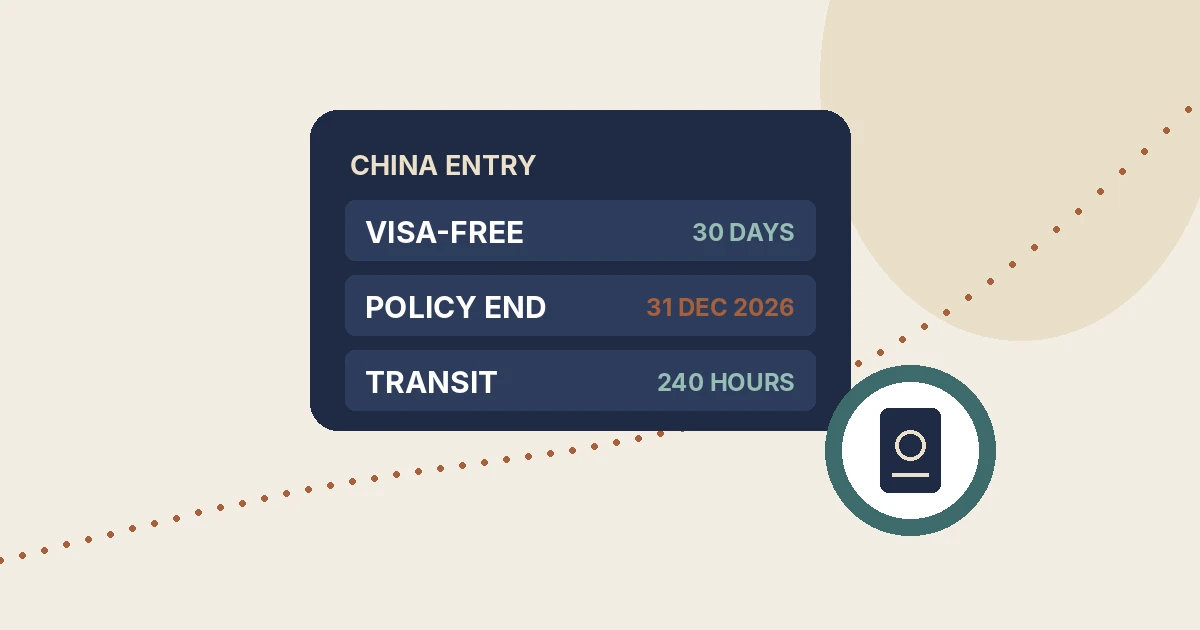
China has become one of the easiest big destinations to visit in Asia. Visa-free entries rose by about a quarter in the third quarter of 2026, and they now make up more than three quarters of all foreign arrivals. The catch: the 30-day visa-free policy that most Europeans, Brits, Canadians and Australians rely on is currently set to end at midnight Beijing time on December 31, 2026, and no extension had been announced when we wrote this. Here is what that means for your trip.
Status, October 27, 2026: no extension for 2027 has been announced yet. In past years China renewed the policy each November (in 2023, 2024 and on November 3, 2025), so a decision is likely in the coming weeks. We will update this page as soon as it is published.
Quick answer
- Who can enter visa-free for 30 days: ordinary passport holders from 50 countries, including the UK, Canada, Australia, New Zealand, Japan, South Korea and most of the EU.
- End date: December 31, 2026 for most of them. Russia's runs to December 31, 2027 and Brunei's has no end date.
- Americans: the US is not on the 30-day list, but US citizens can use 240-hour (10-day) visa-free transit, or Hainan's own 30-day visa-free program.
- Trip in January or February 2027? Prepare a visa application in parallel, rather than betting on an extension.
- Trip before December 31? Nothing changes. Enter with your passport and a return or onward ticket.
Who Can Enter China Visa-Free Right Now
China's "unilateral" visa-free policy lets ordinary passport holders from 50 countries stay for up to 30 days for tourism, business, visiting family or friends, exchange visits or transit. Work, study and journalism always need a visa.
| Group | Examples | Current end date |
|---|---|---|
| Most EU and European countries | France, Germany, Italy, Spain, the Netherlands, Sweden and others | December 31, 2026 |
| UK and Canada (added February 17, 2026) | United Kingdom, Canada | December 31, 2026 |
| Asia-Pacific | Australia, New Zealand, Japan, South Korea | December 31, 2026 |
| Other regions | Including Brazil and several Gulf states | December 31, 2026 |
| Russia | Russia | December 31, 2027 |
| Brunei | Brunei | No end date |
Separately, about two dozen countries have long-standing mutual visa exemption agreements with China that do not depend on this deadline. Check your country's Chinese embassy page if you are not sure which scheme applies to you.
What Happens After December 31, 2026?
There are three realistic outcomes, and nobody outside the Chinese government knows which one it will be:
- A renewal for 2027, most likely announced in November, as happened in each of the last three years.
- A renewal with changes: countries added or removed, or different terms.
- No renewal for some or all countries, which would mean applying for a visa again.
The official notices do not say how a stay that starts in late December and ends in January will be treated. If your trip crosses the year end, ask the Chinese embassy or call the 12367 immigration hotline before you book, or apply for a visa to be safe.
Our advice: if you have non-refundable flights in January or February 2027, start preparing a visa application one to two months before you travel. If an extension is announced, you simply do not submit it.
Americans: 240-Hour Visa-Free Transit and Hainan
US citizens are not on the 30-day list, but there are two good ways to visit without a visa:
240-hour (10-day) visa-free transit
- Open to citizens of 57 countries, including the US, and not tied to the December 31 deadline.
- You must be transiting to a third country or region: for example US – Shanghai – Tokyo. A round trip US – China – US does not qualify. Hong Kong, Macao and Taiwan count as a third region.
- You need a confirmed onward ticket and must enter through one of the 65 designated ports. You can travel between the 24 permitted provincial-level regions.
- The 240 hours start at midnight after your arrival day, so in practice you can stay up to 11 calendar days.
- Tell the airline at check-in that you are using visa-free transit.
Hainan 30-day visa-free entry
The tropical island province of Hainan runs its own visa-free program, and the US is on it. Fly directly into Haikou or Sanya from outside mainland China and you can stay in Hainan for up to 30 days.
Before You Go: Phone, Internet and Payments
Two things trip up first-time visitors more than visas: internet access and paying for things.
- Internet: Google, WhatsApp, Instagram and many Western sites are blocked on Chinese networks. Travel eSIMs from international providers usually route your data outside mainland China, which is why many travelers find these apps work on them, but it is not guaranteed. Read our guide on whether you need a VPN when traveling and set everything up before you fly.
- eSIM: compare Saily, Yesim and Drimsim plans for China, or see our full best eSIM for international travel comparison.
- Payments: China runs on mobile payments. Alipay and WeChat Pay both accept foreign Visa and Mastercard cards, so link one before departure and carry some cash as a backup.
- Insurance: a medical evacuation from China can be very expensive. Our travel insurance guide explains what to look for, or get a quote from EKTA.
China Trip Checklist for 2026–2027
- Check which scheme you qualify for: 30-day visa-free, 240-hour transit or Hainan
- Passport valid for at least 6 months
- Return or onward ticket booked
- Trip after December 31, 2026? Visa application ready as a backup
- eSIM installed and tested at home
- Alipay or WeChat Pay linked to your card
- Travel insurance with medical cover
FAQ
Will China extend visa-free entry into 2027?
No extension had been announced as of October 27, 2026. China renewed the policy each November in 2023, 2024 and 2025, so an announcement is likely in November 2026, but it is not guaranteed and the list of countries could change.
Can US citizens visit China without a visa?
Not for a standard 30-day trip. US citizens can use 240-hour visa-free transit if they continue to a third country or region, or Hainan's 30-day visa-free entry if they fly directly into Haikou or Sanya from outside mainland China.
Does the 240-hour transit end on December 31, 2026 too?
No. The 240-hour transit policy is a separate, standing policy and is not tied to the December 31, 2026 deadline of the 30-day visa-free scheme.
What if my trip starts in December 2026 and ends in January 2027?
The official notices do not say how stays that cross the deadline are treated. Contact the Chinese embassy or the 12367 hotline before booking, or apply for a visa to be safe.
Can I work or study in China visa-free?
No. Visa-free entry covers tourism, business meetings, family visits, exchange visits and transit. Work, study and journalism require the proper visa.
Do Google and WhatsApp work in China?
Not on Chinese networks. Many travelers use an international travel eSIM, which usually routes data outside mainland China, or a VPN set up before arrival. Neither is guaranteed, so download offline maps and translation apps before you go.
Affiliate Disclosure: The Finer Route earns a commission from some of the services linked in this article, at no extra cost to you. Visa rules can change at short notice, so confirm the current policy with the Chinese embassy or the official sources above before you travel.