
Most travelers still land in a new country and do one of two things: switch on roaming and hope the bill won't hurt, or join the line at the airport SIM kiosk. A travel eSIM avoids both. You install it on your phone at home, and when the plane touches down you're on a local network before you've unbuckled your seatbelt.
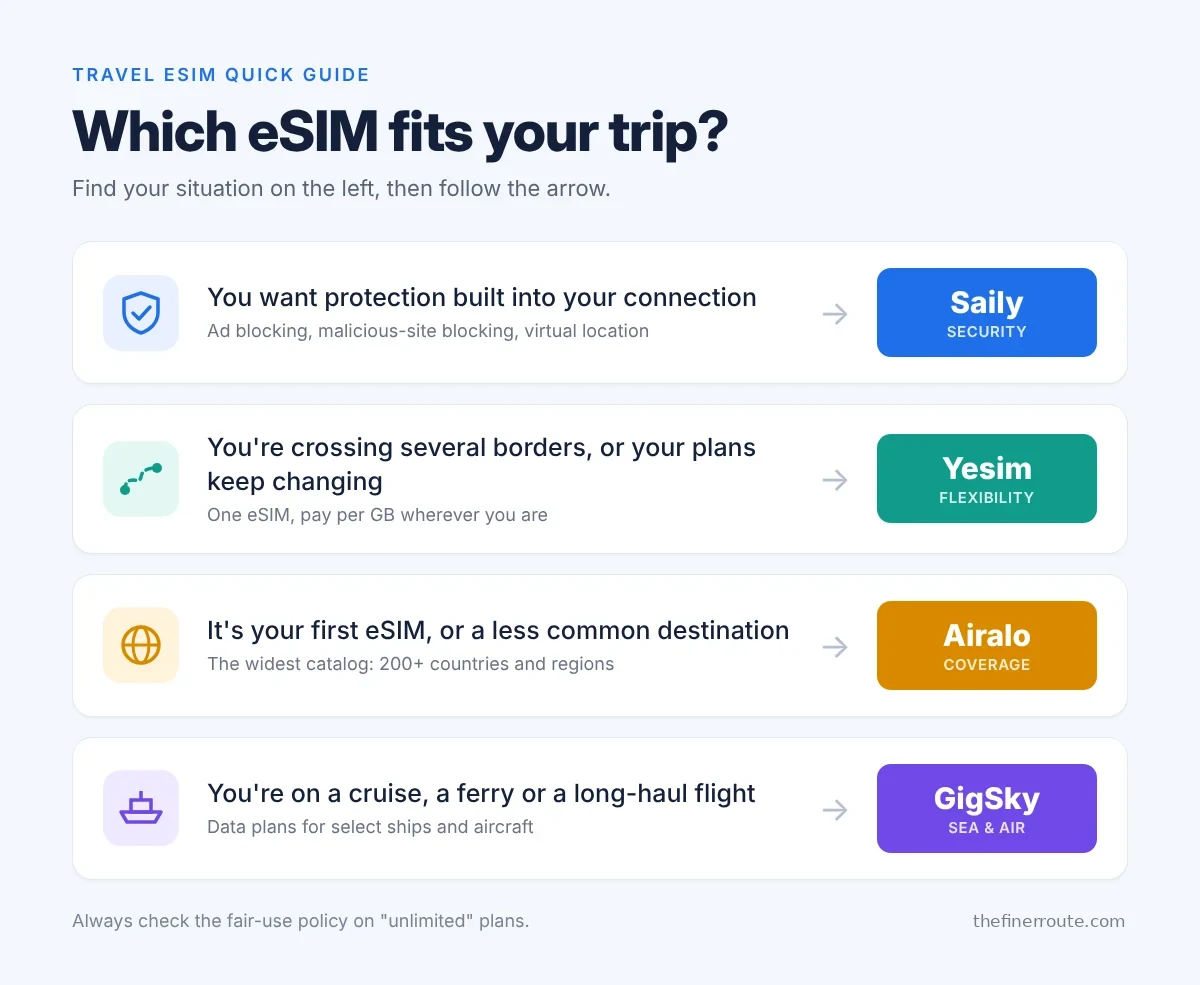
The catch is that the big eSIM brands aren't interchangeable. One is built around security, another lets you pay per gigabyte across 170+ countries, a third has the widest catalog, and the fourth even works on some planes and cruise ships. Picking the wrong one usually doesn't leave you offline. It means you pay for features you don't need, or run into a "fair use" limit halfway through the trip.
Below are the four providers we think are worth your money in 2026, what each one does best, and the fine print most comparison posts skip.
How we put this together: we compared each provider's plan types, fair-use policies and extra features. We also read through recent customer reviews on Trustpilot (September–October 2026) to see what travelers actually praise and complain about. Those experiences are summarized under each provider, with links so you can read the originals.
Quick Picks
Best for security-minded travelers: Saily
Best for flexible, multi-country trips: Yesim
Best for first-timers and widest coverage: Airalo
Best for cruises and in-flight data: GigSky
Phone doesn't support eSIM? Drimsim, a physical travel SIM card
Before You Buy: The 60-Second Compatibility Check
No eSIM will help if your phone can't use it. Two things have to be true:
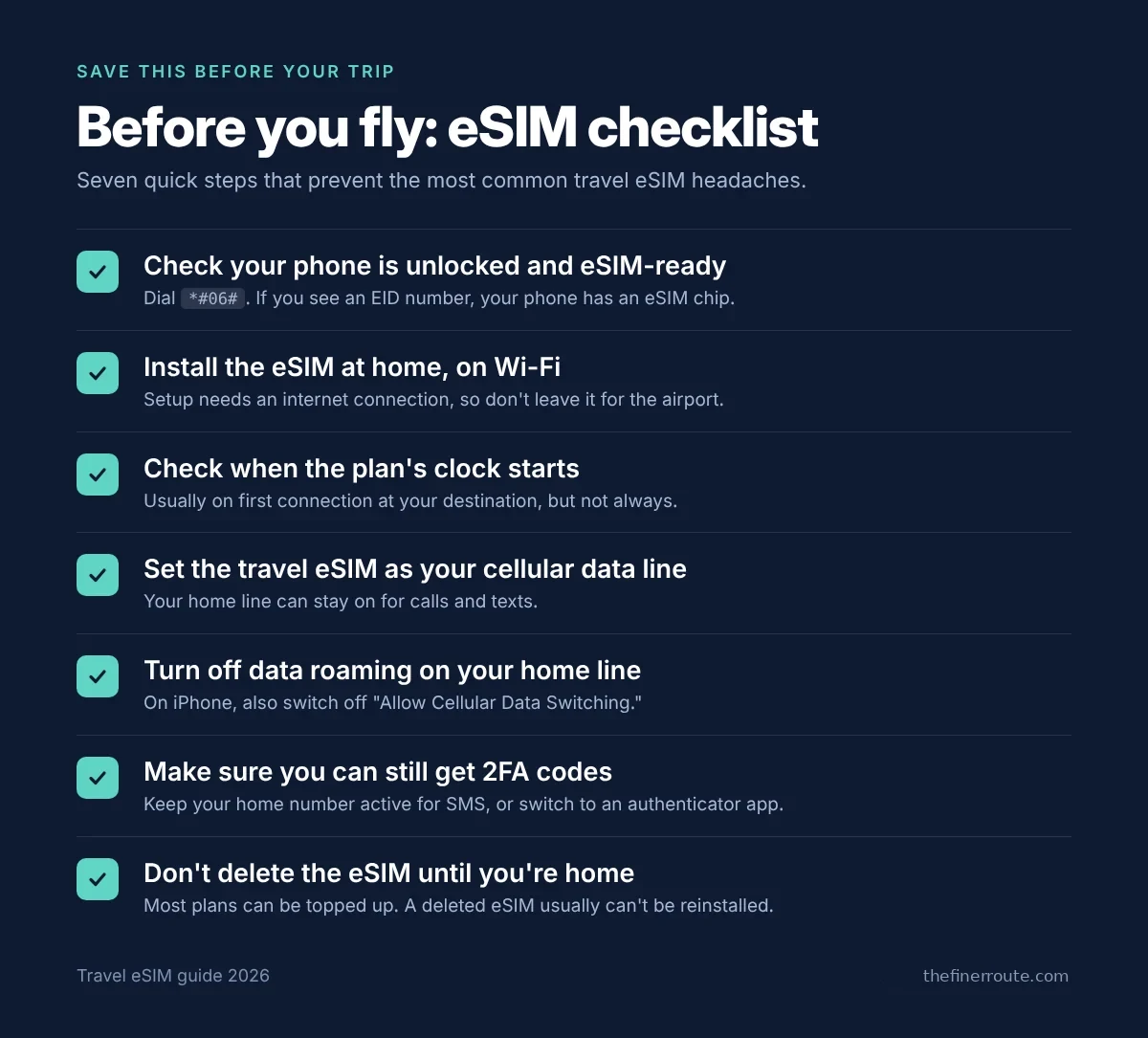
- Your phone supports eSIM. That covers iPhone XS/XR and newer, Google Pixel 3 and newer, and most Samsung Galaxy S, Z and recent A-series models. iPhone 14 and later models sold in the US are eSIM-only, so they're fine. Quick test: dial *#06#. If you see an EID number, your phone has an eSIM chip.
- Your phone is carrier-unlocked. A phone still locked to your carrier, which is common with financed phones, will usually refuse a third-party eSIM. On iPhone, go to Settings → General → About and look for "No SIM restrictions." If you're not sure, ask your carrier before the trip, not at the gate.
1. Saily: Best for Security-Minded Travelers
Built by the NordVPN teamSaily comes from Nord Security, the company behind NordVPN, and that's what sets it apart from other eSIM apps. On top of mobile data, every plan includes a set of protection features that run at the network level.
This matters more on the road than at home. When you travel, you tap far more unfamiliar links than usual: booking confirmations, airport Wi-Fi login pages, QR-code menus on restaurant tables. QR-code phishing is a real and growing scam. A connection that quietly blocks known malicious domains is a sensible default when you're tired and in a hurry.
Key features
- Ad blocker using DNS filtering. Saily says it also cuts data use, because ads never load.
- Web protection that blocks access to known malicious websites.
- Virtual location with 100+ locations, handy when a streaming service or bank app expects you to be in a specific country.
- Optional US phone number for calls, texts and 2FA codes. It's a low-cost monthly add-on and requires identity verification.
- Local, regional and global plans, unlimited options, and an Ultra subscription tier for frequent travelers.
- 24/7 live chat support.
Pros: security features included at no extra cost; clean, beginner-friendly app; hotspot sharing and mid-trip top-ups.
Cons: the phone number costs extra and needs ID verification; the local carrier isn't always shown before you buy; refunds after activation are limited.
What travelers say about Saily ★ 4.7/5 (31,000+ Trustpilot reviews)
The most common theme is how little effort setup takes. Reviewers describe installing the eSIM in a few minutes and forgetting about it. Support also comes up a lot, and not just as "they were polite":
- One traveler's phone broke mid-trip, and the eSIM couldn't be moved to the new phone the usual way. Saily's support found a workaround and returned the unused part of the plan as credits.
- A first-time eSIM user on the Regional Europe plan said installation was straightforward and the network was strong throughout the trip.
- Another reviewer accidentally bought a plan for the wrong country. It was sorted out as soon as they landed.
- Several reviewers simply note it came out much cheaper than their home carrier's roaming.
The complaints: a minority report the connection failing in specific destinations. Some were frustrated with the chatbot on payment or activation problems before reaching a human.
Source: Saily on Trustpilot. Rating as of October 2026.
Who it's for: anyone who already uses a VPN or password manager, remote workers on public networks, and travelers who'd rather not think about which link is safe to tap.
2. Yesim: Best for Flexible, Multi-Country Trips
Swiss-based, pay-as-you-goYesim is a Swiss company, founded in 2019 and based in Baar. It works as an aggregator, with access to hundreds of carriers and roaming partners. Its standout feature is the Pay As You Go eSIM. Instead of buying a separate plan for every country, you install one eSIM, keep a balance on it and pay per gigabyte wherever you are, across 170+ destinations.
For a route like Lisbon → Marrakech → Istanbul, this is far less hassle than juggling three plans. The trade-off is that per-GB rates vary a lot by country. Data is cheap in much of Europe and noticeably pricier in remote destinations. Check the rate for each stop before relying on Pay As You Go for a long stay.
Key features
- Pay As You Go global eSIM with no fixed expiry. You top up as needed.
- Classic local, regional and global packages, plus unlimited plans. These have a fair-use cap, so read the speed policy.
- Scheduled activation: you can set the plan to start on a specific date, so validity days aren't wasted before you fly.
- The app shows which local networks your plan uses in each country.
- Built-in VPN in the app. Check that it's available on your platform.
- Virtual numbers in a handful of countries, mainly for receiving SMS verification codes.
Pros: Pay As You Go suits unpredictable itineraries; a scheduled start date protects your plan days; 24/7 support via chat and WhatsApp.
Cons: per-GB rates swing widely between countries; traffic may route through another country, adding latency on video calls; more options means a busier app.
What travelers say about Yesim ★ 4.3/5 (~3,000 Trustpilot reviews)
Yesim's reviews split clearly by plan type. People on regular and Pay As You Go plans tend to be happy:
- One reviewer has been running the Pay As You Go plan for over a year and singles out how simple and flexible it is.
- A frequent traveler wrote that Yesim was more reliable than the eSIMs they'd used before.
The complaints center almost entirely on unlimited plans, and Turkey comes up again and again:
- One buyer only found out about a 5 Mbps speed cap on their Turkey plan after paying.
- Another reported speeds dropping after about four days on a 29-day "unlimited" Turkey plan.
- Another reviewer hit a data cap despite buying unlimited. A visitor to Tunisia got only a weak 3G signal, and the refund was approved only after escalating.
Our read: this confirms the fair-use warning in our buying guide. With Yesim, fixed-size and Pay As You Go plans are the safer bet. If you go unlimited, read the speed policy before you pay.
Source: Yesim on Trustpilot. Rating as of October 2026.
Who it's for: multi-country trips, digital nomads, and anyone whose plans tend to change mid-trip.
3. Airalo: Best for First-Timers and Widest Coverage
200+ destinationsAiralo is the name most people hear first, for good reason. It covers 200+ countries and regions, reports more than 30 million users, and its app makes the whole process simple: pick a country, pay, tap install. For popular destinations like the US, Japan, Italy or the UK, entry-level plans start at around $4.
Key features
- Local, regional and global eSIMs. Regional plans cover areas like Europe and Latin America, and the global plans are sold under the Discover name.
- Discover+ global plans add calls, texts and a phone number, which is rare among travel eSIMs.
- Top-ups without reinstalling the eSIM.
- Airmoney rewards: store credit on every purchase, which adds up if you travel a few times a year.
- Unlimited plans in select destinations: full speed up to 3 GB per day, then 1 Mbps.
Pros: huge catalog, so almost any destination is covered; low entry prices for short trips; the easiest setup for eSIM beginners.
Cons: no built-in security features; most plans are data-only; some countries require ID verification before purchase; no phone support (chat, email and WhatsApp only).
What travelers say about Airalo ★ 4.1/5 (45,000+ Trustpilot reviews)
With the biggest user base of the four, Airalo also has the widest range of experiences. On the positive side, one detail keeps coming up: support over WhatsApp.
- Several reviewers whose automatic install failed say an agent walked them through entering the code manually and got them connected.
- One traveler reported a reliable connection across several Asian countries on a single trip.
- Another lost signal near the Spain–Portugal border, contacted support and had it fixed quickly.
The complaints: connection drops at awkward moments, such as when one eSIM package ran out and a top-up kicked in. Others mention weak or inconsistent speeds in some places. A long-time user complained that data seemed to drain faster than usual on a recent trip.
Source: Airalo on Trustpilot. Rating as of October 2026.
Who it's for: your first eSIM, short city breaks, and destinations that smaller providers don't cover.
4. GigSky: Best for Cruises and In-Flight Data
Works at sea and in the airGigSky has been around since 2010 and was one of the early eSIM players. It's not the cheapest option on land, but it does something the others don't: it sells data plans for cruise ships, ferries and select aircraft.
If you've ever paid for a ship's Wi-Fi package, you know why that's appealing. GigSky lists cruise plans for major lines, including lighter "messaging" plans for WhatsApp, maps and email. In-flight data depends on the specific aircraft and route, not just the airline, so check your exact flight in the app before you count on it.
Key features
- 190+ countries with local, regional and global plans.
- Cruise, ferry and in-flight data plans.
- Free 100 MB trial plan, a smart way to test installation before you pay.
- Unlimited plans are available but slow down after about 2.5 GB per day.
Pros: connectivity where other eSIMs can't reach; a free trial to check compatibility; a long track record.
Cons: pricier than budget competitors; data at sea or in the air costs far more per GB; no refunds after purchase; data-only, with no calls or SMS.
What travelers say about GigSky ★ 4.3/5 (6,600+ Trustpilot reviews)
GigSky's fans are often cruise passengers, and that's where it shines:
- One reviewer said setup was effortless and the service worked everywhere they needed it, cruise ship included.
- Another wrote that GigSky kept working on a trip where competing eSIMs failed.
The complaints are about coverage on land, and they're specific:
- Full signal bars but no working data in Alicante, Spain.
- Slow or no service while driving in parts of England.
- Weak coverage along stretches of the Italian coast.
- One traveler said the eSIM stopped working after a few days in Barcelona and never connected in Greece.
- A reviewer in Hong Kong only got LTE and found it slower than other eSIMs. Another reported a poor connection in China.
Our read: GigSky is the specialist pick for sea and air. For a land-only trip, one of the other three is usually the better value.
Source: GigSky on Trustpilot. Rating as of October 2026.
Who it's for: cruise passengers, island-hoppers on ferries, and long-haul flyers who need to stay reachable.
Side-by-Side Comparison
| Provider | Best for | Trustpilot* | Coverage | Standout feature | Phone number option | Watch out for |
|---|---|---|---|---|---|---|
| Saily | Security | 4.7 | Global | Ad blocker, web protection, virtual location | US number (paid add-on) | Limited refunds after activation |
| Yesim | Multi-country trips | 4.3 | 170+ (Pay As You Go) | One eSIM, pay per GB anywhere | Virtual numbers for SMS codes (few countries) | Per-GB price varies by country |
| Airalo | First-timers | 4.1 | 200+ | Largest catalog, Airmoney rewards | Discover+ plans | Unlimited throttles after 3 GB/day |
| GigSky | Cruises and flights | 4.3 | 190+ | Data at sea and in the air | No | Higher prices, no refunds |
*Trustpilot rating out of 5, as of October 2026. Prices and plan details change often. Check the provider's app for current rates before you buy.
Buying Guide: What Most eSIM Guides Don't Tell You
1. Estimate your data honestly
As a rough rule, maps, messaging and light social media use about 0.5–1 GB a day. Add video calls, Instagram Stories or streaming and you can easily reach 2–3 GB or more. For a week in one city, a 5–10 GB plan is usually enough for most people. Heavy users should look at unlimited plans, with the caveat below.
2. "Unlimited" almost never means unlimited
Nearly every unlimited plan has a fair-use policy. You get full speed up to a daily or monthly cap, then you're throttled, often to around 1 Mbps. That's fine for WhatsApp and maps and painful for video calls. Always read the speed policy, not just the headline.
3. Check whether hotspot is allowed
Planning to work from a laptop? Make sure the plan allows tethering. Most do, but it's one of the details that varies by provider and plan type.
4. Understand "data-only"
Most travel eSIMs give you data, not a local phone number. WhatsApp, iMessage, FaceTime and Wi-Fi calling still work over data. Regular SMS, including bank verification codes, still goes to your home number. Our recommended setup:
- Keep your home SIM on so you can receive texts.
- Set the travel eSIM as your cellular data line.
- Turn off data roaming on your home line. On iPhone, also disable "Allow Cellular Data Switching." This one setting prevents most surprise roaming bills.
5. Your "location" may look strange
Many travel eSIMs connect to local towers but route your traffic through a hub in another country. That's why Google might suddenly show results in a different language, or a streaming app might think you're somewhere else. It can also add latency on video calls. This is normal, but if you need a local IP, a VPN or virtual-location feature helps.
6. Install before you fly, but check when the clock starts
Download and install the eSIM at home on Wi-Fi, because you need a connection to set it up. With most providers, plan validity starts when the eSIM first connects to a supported network at your destination, not at installation. That's not universal, though, so check the details. Yesim lets you schedule the start date.
7. Don't delete the eSIM until you're home
Run out of data mid-trip? Most providers let you top up the existing eSIM. Delete it and you usually can't reinstall it.
Phone doesn't support eSIM? A physical travel SIM is the fallback. Drimsim makes a universal SIM card that works in close to 200 countries and is managed through an app. Order it well before your trip, since it ships by post.
Traveling? Don't Forget Your Smart Home
Here at The Finer Route, this is the part we care about most. A reliable connection abroad isn't only about maps and Instagram. It's also how you keep an eye on an empty house. A few minutes before you leave:
- Test remote access to your cameras and doorbell while on mobile data, not home Wi-Fi.
- Expect login checks. Some security apps flag sign-ins from a new country. Use an authenticator app instead of SMS codes, or make sure your home number can still receive texts.
- Update firmware on cameras and hubs before you go, so an automatic update doesn't knock a device offline while you're away.
- Prefer cellular data over open Wi-Fi when you check your security apps, especially in airports and hotels.
FAQ
Will WhatsApp keep my number on a travel eSIM?
Yes. WhatsApp is tied to your account and phone number, not to the SIM that provides data. It works normally over your travel eSIM's data connection.
Can I use my regular SIM and a travel eSIM at the same time?
Yes, on dual-SIM phones, which includes most modern iPhones and Androids. Your home line handles calls and texts while the eSIM handles data.
Is a travel eSIM cheaper than my carrier's roaming?
For data, usually by a wide margin. Carrier international day passes often cost $10 or more per day, while a week of data on a travel eSIM can cost less than a single day pass. Always compare against your own carrier's current rates.
Can I use one eSIM for several countries?
Yes. Choose a regional or global plan, or Yesim's Pay As You Go eSIM, which charges per GB in whichever country you're in.
The Verdict
There's no single "best" travel eSIM, only the best one for your trip:
- Want protection built into your connection? Saily.
- Crossing several borders, or your plans keep changing? Yesim.
- First eSIM, or a less common destination? Airalo.
- Cruise, ferry or a long-haul flight? GigSky.
- Phone doesn't support eSIM at all? A Drimsim physical travel SIM.
Whichever you choose, install it at home, read the fair-use policy, and switch off data roaming on your main line. Those three steps will save you more money than any discount code.
Plan prices and features were checked at the time of writing (October 2026) and may change.
Affiliate Disclosure: The Finer Route earns a commission from some of the services linked in this article, at no extra cost to you. Plans, prices and features change often, so check the current details before you buy.