Short answer: for a few mountain days a year, textile snow socks are the easier choice: they weigh little, go on in a few minutes and are accepted by Colorado (AutoSock is on CDOT’s approved list), by Yosemite and, when certified to EN 16662-1, in France’s mountain zones. Chains grip better on ice and last far longer, so pick them for frequent winter driving. Either way they must match your exact tire size, and on a US rental car check the agreement first: most companies ban chains unless the law requires them.
Affiliate note: Some links in this guide go to Amazon. As an Amazon Associate, The Finer Route earns from qualifying purchases, at no extra cost to you. Rules come from the official transport departments linked at the end.
I’ve put snow chains on myself in the mountains, and it’s the kind of job that is easy in a dry parking lot and much harder on a cold, snowy shoulder. I’ve also driven Romanian mountain roads in a Nissan Pathfinder on tires that weren’t up to the job: on ice, sharp bends and steep descents, the car simply didn’t hold the road the way it should. Since then I treat traction as part of trip planning, like the vignette and the route.
This guide is for anyone heading to the mountains this winter, from Thanksgiving at Tahoe to Christmas in the Alps: what the law asks for where you’re going, whether snow socks count, and the rental-car rule that catches a lot of travelers.
Route checker: chains, socks or nothing?
Choose where you’re driving, your car and your tires. The checker shows what you must carry or fit and whether snow socks count. It covers passenger cars and small SUVs, not trucks or cars towing a trailer.
Summary of the official rules linked at the end, checked October 30, 2026. Road signs and officers on the day always win.
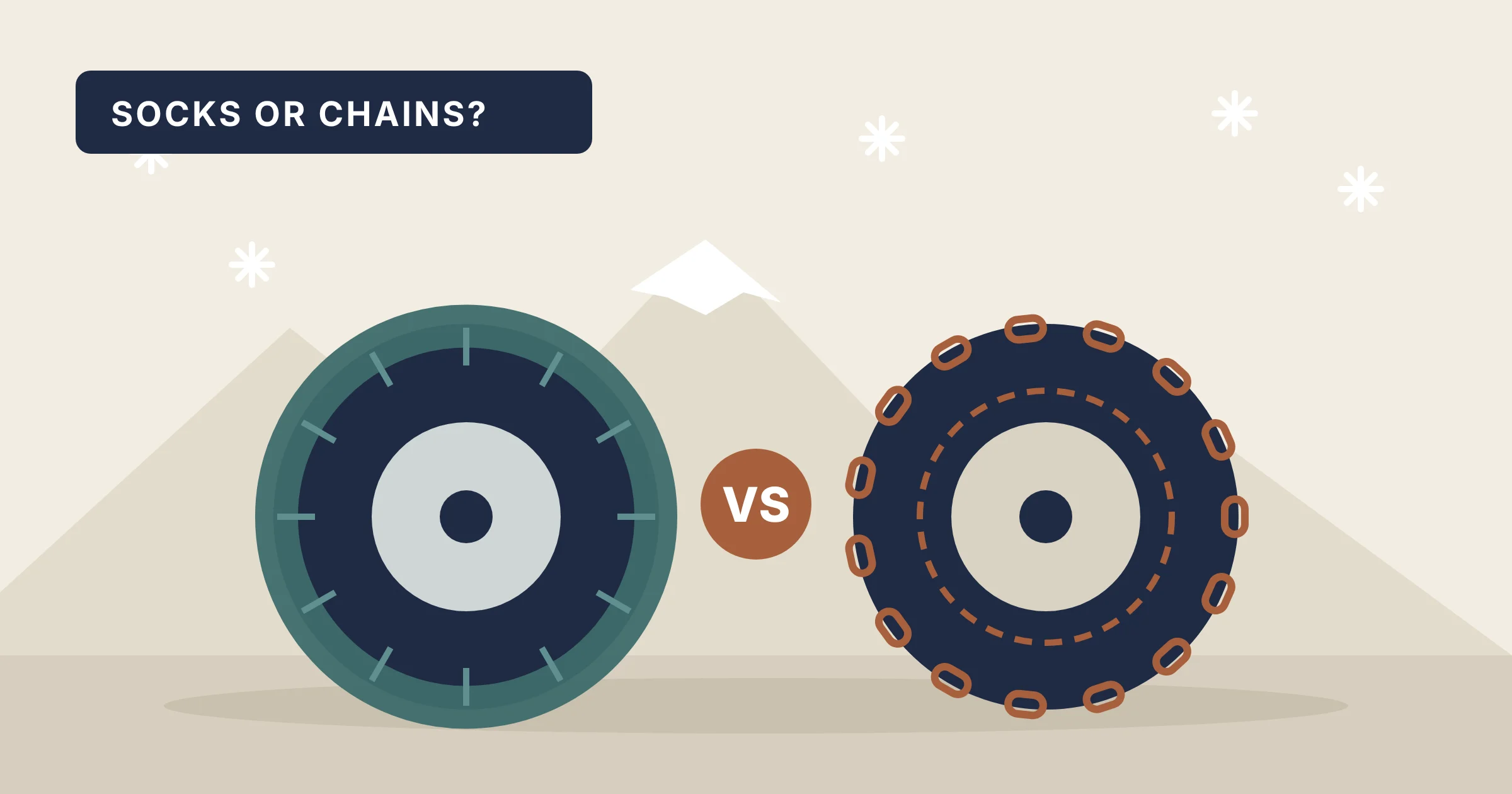
Snow socks vs chains compared
| Textile snow socks | Cable chains | Link chains | |
|---|---|---|---|
| Fitting | Easiest: pull over the top, roll the car forward, finish | Moderate; some self-tighten | Hardest the first time |
| Grip on packed snow | Good | Good | Best |
| Grip on ice | Weakest | Fair | Best |
| Wheel clearance | Fine for low-clearance cars | Many are low-profile (“Class S”) | Check the manual: many cars can’t take them |
| Wear | Wear fast on dry pavement | Medium | Long life |
| Best for | A ski week, a holiday trip, rental-sized trunks | Regular mountain driving | Heavy snow, steep private roads |
My rule: if you drive in the mountains a few days a year, socks. If you live up there or drive passes every weekend, chains. And whichever you buy, take them off as soon as you’re back on clear pavement: driving on bare road is what destroys socks and loosens chains.
The US rules: California, Colorado, Yosemite
California chain controls
When chain controls are up, signs show one of three levels:
- R1: chains required, except on cars and light trucks under 6,000 lb with snow tires on at least two drive wheels. Caltrans adds that vehicles on snow tires must still carry chains.
- R2: chains or traction devices required on all vehicles except 4WD and AWD with snow-tread tires on all four wheels. Those must carry traction devices in the chain control area.
- R3: chains or traction devices on all vehicles, no exceptions.
Caltrans accepts “tire traction devices” without naming brands and tells drivers to follow the car maker’s specifications. Chain installers work at many control points, but in a storm the line can be long. The California Highway Patrol can cite drivers who skip the chains.
Yosemite
The park’s rule is stricter in practice: when chain controls are in effect, you must have chains or cables with you even in a 4WD or a rental car, and the National Park Service says tire socks are acceptable. Plastic devices and straps are not.
Colorado’s Traction Law on I-70
From September 1 to May 31 the Traction Law can be switched on along I-70 between Dotsero and Morrison, and on other highways when weather requires. Under the rules CDOT announced in November 2025, every car needs tires with at least 3/16 inch of tread that are winter (mountain-snowflake), all-weather or M+S rated, regardless of drivetrain. If your tires don’t qualify, you need chains or an approved alternative traction device, and CDOT’s list includes AutoSock. In a severe storm CDOT can switch on the Passenger Vehicle Chain Law, the last step before closing the road: then every car needs chains or an approved device. Fines are highest if an unprepared car blocks a lane: CDOT lists $500 plus a surcharge.
The Alps and Europe
Europe mostly asks for winter tires, and chains are what you carry or fit where signs demand them. The country details, dates and vignettes are in my Europe vignettes and winter tire guide; here is what matters for chains and socks:
- France: from November 1 to March 31, signed mountain zones require snowflake winter tires, or chains or socks in the car. Socks certified to EN 16662-1 are accepted as an alternative.
- Austria: winter tires whenever there’s snow, slush or ice from November 1 to April 15; chains are allowed on snow-covered roads and required where a sign shows them.
- Italy: from November 15 to April 15 on signed roads, winter tires or chains on board (Aosta Valley from October 15).
- Slovenia and Croatia: winter tires from November 15, or summer tires with chains in the car.
Because the law requires them, cars rented in Alpine countries in winter are often on winter tires, while a car rented in a warm city and driven up into the mountains may not be. Check the tire sidewall for the mountain-snowflake symbol before you leave the lot, and ask whether chains are available.
The rental car catch
Here’s the part many travelers learn at the counter. Most big US rental companies don’t rent chains and don’t want them on their cars. Enterprise, for example, says it doesn’t offer chains or traction devices and that they can’t be installed on its vehicles unless state law requires them; in Colorado they’re allowed during Code 15/16 advisories. Meanwhile Yosemite says rental cars are not exempt from its chain rule.
So what do you do? Before the trip:
- Read the rental agreement’s section on chains and unpaved roads, or call the location.
- Ask for an AWD car with M+S or snowflake tires. It doesn’t remove every requirement, but it gets you through Colorado’s Traction Law and California’s R2 in most cases.
- If the law where you’re going can require chains and the agreement allows them when required, buy socks or chains that fit the rental’s tire size (it’s printed on the sidewall). Fit them only when signs require it, and take them off after.
- If the forecast is bad and nothing fits, change the plan: a shuttle to the ski area, or a day’s wait, is cheaper than a crash.
How to get the right size
Chains and socks are sold by tire size, so a “universal” set doesn’t exist. Read the size off the tire sidewall, for example 225/65 R17: width 225 mm, profile 65, wheel 17 inches. Then:
- Use the maker’s size chart for that exact size. One set fits several sizes, but the chart is the only way to be sure.
- Check your owner’s manual for chain clearance. Many modern cars allow only low-profile (“Class S”) chains or socks, and some say no chains at all.
- Chains go on the drive wheels: the front on front-wheel drive, the rear on rear-wheel drive. On AWD, the manual says which.
Fitting them on a cold roadside
The steps that make it easier:
- Practice once at home. Fit them in your driveway or the hotel parking lot. The first time is always the slowest.
- Pull fully off the road or into a chain-up area, hazards on, parking brake on.
- Gloves, a headlamp and something to kneel on make a bigger difference than any chain design. Wet knees in the snow get cold fast.
- Socks: pull over the top of the tire as far as it goes, roll the car forward half a turn, then pull the rest over.
- Chains: lay them out untangled, drape over the tire, connect at the back, then the front, then tighten. Stop after a short distance and re-tighten.
- Drive slowly, under the speed shown on the packaging (often around 30 mph or 50 km/h), and remove them on clear pavement.
Cold hands are the real enemy. Keep warmers in the glovebox: here is which hand warmers to pack.
What to buy
I haven’t tested these side by side. The picks follow the official lists above and what each type is designed for. All are sold by tire size, so the links open the size range: choose yours from the chart.
Easiest for occasional trips: AutoSock textile snow socks
Fabric covers that slide over the tire. AutoSock is on Colorado’s approved traction device list, and the maker says its socks meet EN 16662-1, the European standard France accepts. Light, compact and suitable for many low-clearance cars.
Good: minutes to fit, fits in any trunk, no metal against your wheels.
Watch out: wears quickly on dry pavement; weakest on sheet ice.
Low-clearance cable chains: Security Chain Super Z6
Cable-style traction chains with a low profile, made for passenger cars and SUVs with tight wheel wells. A good middle ground between socks and full link chains.
Good: better on ice than socks; compact.
Watch out: fitting takes practice; check the size chart carefully.
Self-tightening chains: Peerless Auto-Trac
Link-style chains with a ratchet that tightens as you drive, so you don’t have to stop and re-tighten. Popular with SUV and light-truck owners who drive mountain roads often. Check that your car’s clearance allows them.
Good: strong grip; tighten themselves.
Watch out: heavier and bulkier; not for cars that require low-profile chains.
The small kit that makes it bearable
None of these is exciting, but they make a cold roadside job much easier.
FAQ
Are snow socks legal instead of chains in California?
Under chain controls R2 and R3, Caltrans accepts chains or traction devices and doesn't name brands. Yosemite National Park says tire socks are acceptable. Check that the socks fit your exact tire size and follow your car's manual.
Are AutoSocks approved in Colorado?
Yes. CDOT's list of approved alternative traction devices includes AutoSock, plus several other textile and cable devices. They count where the Traction Law or the Passenger Vehicle Chain Law requires chains or an approved alternative.
Can I put chains on a rental car?
Most US rental companies ban chains and don't rent them. Enterprise says traction devices can't be installed on its cars unless state law requires them, and that in Colorado they are allowed during Code 15/16 advisories. Read your rental agreement before you buy chains.
Do I need chains with all-wheel drive?
Often you still have to carry them. In California, 4WD and AWD cars with snow-tread tires on all four wheels are exempt from R2 but must carry traction devices in chain control areas, and R3 applies to everyone.
Are snow socks accepted in France?
France's mountain law requires winter tires or chains or socks in the car from November 1 to March 31 in signed mountain zones, and socks are accepted as an alternative. Look for socks certified to EN 16662-1.
Snow chains or snow socks: which is better?
Socks are lighter, fit in minutes and suit occasional use on cars with little wheel clearance. Chains last longer and grip better on ice and deep snow. For a few mountain days a year, socks are usually enough; for frequent winter driving, chains.
Sources
- Caltrans: Chain controls and chain installation (R1, R2, R3)
- National Park Service: Yosemite tire chain requirements
- CDOT: Passenger vehicle Traction and Chain Laws, approved traction devices
- CDOT: New Traction Law requirements (November 20, 2025)
- Enterprise: Can I rent a car with snow chains in the US?
- AutoSock: France's mountain law and EN 16662-1 (manufacturer page)
Affiliate Disclosure: The Finer Route is a participant in the Amazon Services LLC Associates Program. As an Amazon Associate we earn from qualifying purchases, at no extra cost to you. Traffic rules change, so check the official sources before you travel.